


Louis Lepine: Designed for the Impossible


In my last blog, I discussed Prefect Henri-Auguste Lozé and the Student Riots of 1893. My readers will be far more familiar with Lozé than Lépine, having seen Lozé several times in the Callahan Chronicles up to this point, and, if they have read Grayound, will at least know the name of Louis Lépine, who is briefly introduced.
In reality, the opposite is true. Lozé is hardly known, and despite a long career of faithful service to France, is remembered mostly due to his bungling of the Student Uprising (or Student Riot) of 1893. Meanwhile, Louis Lépine's life can hardly be compressed so easily. The contemporary of these two prefects, Alphonse Bertillon, is known as the Father of Forensics and greatly contributed to the science that all modern crime dramas rely upon, but it is Lépine's life that best reflects the drama involved. Rather than focus specifically on his involvement in the Student Riots of 1893, as we did with Henri-Auguste Lozé in my last blog, we must attempt to present a few snippets of his life which will hopefully inspire you to learn more about this remarkable man.

Born in 1846, Louis Jean-Baptiste Lépine was already a man of formidable accomplishments when Premier Dupuy appointed him as Préfet de Police in July of 1893. One month shy of his forty-seventh birthday, he was already an accomplished lawyer, decorated veteran, and police prefect. It is no wonder that he was selected for the role, and no wonder that he excelled in it.
The War Hero
By the age of twenty-three, Lépine had already studied law in both France and Germany. His career as a lawyer pales in comparison to his later accomplishments, but it laid the foundation that he implemented on more than one occasion. At twenty-three, he proved his metal by fighting in the Franco-Prussian War, resisting continual attacks by Prussian troops in North-eastern France and refusing surrender. His grit gained him the Médaille Militaire, the third highest honor in France, and one given specifically for acts of bravery in action against a military force. His service in the military lasted only a year, as did the war.
After the war, Lépine put his legal skills to great use, first as a lawyer, then moving up into governmental administration as firstly a sub-prefect, then prefect, in several regions, ending in the Seine-et-Oise, where he served during the Student Riots of 1893. It must be noted that the French term “Préfet” does not necessarily correlate to “Police Chief” as we understand it. A prefect is the state's representative in any department, and is tasked with upholding and enforcing the law in their specific department. While Paris has a Prefect of Police, there are also Departmental Prefects, Regional Prefects, and Maritime Prefects. The Prefect of Police is much like the American Police Commissioner, focused on policy and administration rather than day-to-day duties.
During his time as prefect of the Seine-et-Oise, I represent Lépine in Grayhound as something like a police chief, working in the rural areas surrounding Paris. This is largely for story consistency and to link him to my fictional inspector, Jean Fournier, but mostly incorrect. His duties as prefect of the Seine-et-Oise likely would not have comprised much that fell under the realm of modern policing. Rather, his duties would have more aligned with infrastructure: sanitation, traffic flow, road repair, general maintenance, military maneuverability, etc. These two roles were not simply police captains in different regions, but distinct positions, just as “Police Commissioner” and “County Commissioner” are distinct. However, the skills gained here, like the skills learned from his time as a lawyer, would prove worthwhile during his tenure as Prefect of Police.
The Little Man with the Big Stick
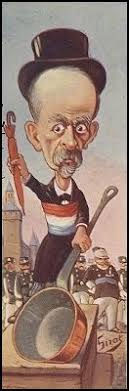
Louis Lépine left his position as prefect of the Seine-et-Oise and stepped right into a freshly-beaten hornets nest. Though Dupuy had done the sensible thing and summoned 20,000 troops to quell the riots before they got even more out of hand, it still left a bloodied and wounded Paris licking its wounds and eager to lash out again. Lépine was reluctant to use military force more than absolutely necessary, but neither could he let the rioters run rampant. Rather than stop the protests entirely by force, he allowed further demonstrations to continue, though carefully monitored and cleverly directed so as to prevent any single demonstration from growing too large. His experience in the army and as Seine-et-Oise Prefect likely contributed to this clever solution that neither let the crowds run rampant nor crushed them so far as to provoke a violent response. His reputation quickly grew to be one of firm fairness that tolerated no nonsense whatever. He managed to walk the line of strict, necessary enforcement without turning despot—a rare quality indeed. He kept the peace for Parisians by any means necessary while never forgetting that peace for Parisians was the goal, thereby earning the title of “The little man with the big stick.”
Knowing this first measure was not enough, he undertook the long-needed duty of modernizing the French police force. This was a project which Alphonse Bertillon had started some years before while clawing his way into a position of importance despite repeated resistance. By 1893, Bertillon was already head of his own department, the Department of Judicial Identity, but that did not mean the police force at large implemented his work or saw value in it. Lépine's position allowed him full control on police procedural policy, and he saw the value in Bertillon's research despite the fact that Bertillon was far better at studying forensics than he was at presenting his findings.
While Bertillon's identification methods were already employed, it was Lépine who not only added fingerprints to this system—which ultimately proved far more reliable—but also used his experience as a lawyer to codify forensic science into police procedure that every gendarme would need to obey. Before this, criminal investigation relied heavily on hearsay, threats, and eyewitnesses that could easily be bribed or coerced. While practical—and genuinely the only option before modern detective theory—it was also easily corrupted. The prefecture was rife with injustice, and the populace knew it. The year after Lépine's appointment to police prefect, the French President was assassinated, and Lépine realized how dire the situation had become. The police and the populace must find a way to be reconciled, and the populace would not make the first move. The only way forward was transparency and consistency for the department of police.
The Prefect of the Streets
Fingerprints for identity, photography of crime scenes, the beginnings of early forensic science applied to investigation: these were implemented as a matter of procedure, but this was not all. Rather than rely on social connections or nepotism for promotions, Lépine required examinations for all officers seeking promotion within the prefecture, ensuring that those promoted were capable of performing the task and that the same standards were applied to all applicants fairly. While this simple step might seem obvious today, it was quite a step forward for the time, when personal recommendations and letters of introduction were the primary source for judging aptitude, making advancement more about “who you know” rather than “what you know.”
During the height of horse-drawn vehicles and the dawn of motorized carriages, traffic control was a hazardous and complex job. Lépine's experience with infrastructure while prefect of the Seine-et-Oise gave him perspectives on improving traffic patterns, introducing one-way streets and roundabouts to help prevent accidental collisions and improve speed of transportation while lessening the necessity of officers manning intersections. This not only increased the number of available patrolmen for more important tasks but also reduced injuries. To increase the safety of those left on traffic control, white batons were issued to aid in directing traffic, making patrolmen more visible. Another leap forward was Lépine's formation of a bike patrol. In the crowded streets of Paris, horses could be unpredictable, required training and feeding, and might panic, causing injury. Bicycles were equally fast and maneuverable, fully under the control of the patrolman, and took less space (and far less food) when not in use.

Even though the telephone was still in its earliest stages, Lépine installed 500 telephone boxes around the city. Not only could they be used in times of emergency to contact the police and fire departments, but also in reverse as an early-warning system that the police could use to spread information more rapidly. Unlike telegrams, phones required no formal training to use. Anyone could step into the telephone box and report a crime or emergency.
These advancements greatly improved the relationship between the prefecture and the citizens. Not only did they save France from what might have been an ugly revolution but also set the new standard for police procedures all over the world. It is Lépine, just as much as Bertillon, that must be given credit for bringing police into the modern era.
The Same Thing Over Again
Lépine served as Prefect of Police until 1897, when he became Governor General of Algeria in northern Africa. He remained there for two years, returning by request to the position of prefect in Paris during the turmoil of the Dreyfus affair. In brief, a man—ironically Jewish—was arrested, convicted, and imprisoned under suspicion of being a German spy. Later evidence revealed his innocence, but the meantime had Paris in political uproar, with those convinced of Dreyfus's guilt on one side and those convinced of his innocence on the other. Once again, Lépine was called to enter the middle of a delicate situation and somehow find a remedy.
He somehow did. This time his reputation preceded him. He implemented the same tactics of allowing protests without letting them turn violent, successfully managing them only with his police officers rather than relying on military force, which would have only increased tensions. The Dreyfus Affair lasted from Dreyfus's arrest in 1894 all the way to 1906, when Dreyfus was finally exonerated. Thus, Lépine's second term to the office of prefect began much like his first, and he handled it again with delicate firmness. Bertillon, who testified at both trials where Dreyfus was condemned, suffered more damage to his reputation, though quite unjustly. Lépine, however, found his legendary status solidified.
He continued the reforms from his first appointment, serving as prefect until the end of his career in 1913. He retired only a year before the start of the first World War. As Europe marched steadily toward the modern world, Lépine continued to make the French gendarmerie the cutting edge of police work. Before he retired, he formed an official school for officers, teaching the science of forensics and detection. It was unlike anything before, and other nations soon followed. Although his vision was certainly for the future, he still had a mind for the past, and also founded the Museum of Police History, or Musée des collections historiques de la prefecture de police. Another first, this museum is still in existence today; you'll find the link below, should you ever find yourself in Paris and fancy a visit.

Some other notable incidents happened toward the end of Lépine's time as prefect. One of which was The Great Flood of Paris in 1910. The Seine rose 28 feet. Oddly enough, the river never technically broke over the banks, but flooded the city from below, rising from the vast network of sewers, underground railways, and basements. Again, Lépine's experience managing city infrastructure paid off. Having already commissioned a fleet of police boats to patrol the Seine, these were quickly used to evacuate those nearest the river. Police, firemen, and military personnel were recruited, transporting people and goods by boat when the trains flooded, building narrow walkways to navigate flooded streets, and organizing relief shelters in churches and government buildings for those who had to leave their homes.

A second notable incident was the theft of the Mona Lisa, which happened the year after. The thief was finally caught, though only after a prolonged investigation and several false leads. Lépine's initial hunch proved correct, but it was not until the thief appeared in Italy with hopes to sell the painting that the long investigation finally closed. The Mona Lisa was not returned to the Louvre until 1914, a year after Lépine's retirement, but the story is certainly worthy to compare with any heist movie made today.
The year before his retirement, in 1912, Lépine founded La Brigade Criminelle, a specialized police force designed to hunt down high-profile criminals and criminal organizations. Lépine, along with this brigade, hunted down a group of anarchists knows as The Bonnet Gang. Their investigations resulted in a deadly shootout and a rooftop chase.
After his retirement, Lépine continued to stay busy. He had begun a yearly competition for inventors in 1901, and this Councours Lépine continues today. Lépine earned a place in the Académie des Sciences Morales et Politiques, one of the five academies of the Institut de France. In 1928 he finished his memoirs, appropriately titled Mes Souvenirs, which he published the year after and are currently available for free online. You'll find the link below, though I was unable to find an English translation. He died four years later, in 1933, having witnessed—and inspired—the dawn of the modern age.
Louis Lépine's many accomplishments seem almost larger than life. His accomplishments are extraordinary. He faced impossible situations more than once and navigated them brilliantly. As I summed him up in Grayhound, I will sum him up here:
He had never surrendered to the Prussians in Alsace, despite bad odds and countless attacks, and he would not surrender now. The man was a fortress, built with the stones of honor and duty, mortared together with experience and skill, and surrounded by a moat of sheer determination. He would never shirk his duty simply because the task was impossible; Lépine was designed with the impossible in mind.

These blogs are designed to give you a brief look at the true history which plays a part in my novels, The Callahan Chronicles.
For more information on this subject or the Callahan Chronicles, check out these links:
The Callahan Chronicles - by Paul Campbell
Grayhound - buy on Amazon
Mes Souvenirs - free ebook on Google Play
Le musée de la préfecture de Police - Police Prefecture Museum Website
Theft of the Mona Lisa - by Stew Ross
The Father of Modern Police - article by Julie Bossart
Louis Lépine - Wikipedia


Comments